UAE Visa for Land Border Crossings from GCC Countries β€” Complete 2026 Guide

UAE Visa for Land Border Crossings from GCC Countries

Aug 05, 2026
Travelling to the UAE by road from Saudi Arabia, Oman, Qatar, Kuwait or Bahrain? Everything you need β€” every crossing, visa rules, documents and the mistakes that get people turned back.

UAE Visa Requirements at Land Borders β€” The Critical Details

Every year, hundreds of thousands of travellers drive, take buses, or travel by car from Saudi Arabia, Oman, Qatar, Kuwait and Bahrain into the UAE. Whether you are heading to Dubai for a family visit, crossing from Riyadh for a weekend, or driving the Muscat–Dubai route for the first time — what happens at the UAE land border is different from what happens at the airport, and getting the visa part wrong will get you turned back.

This guide covers every official land border crossing into the UAE from GCC countries, the exact visa rules that apply at each one, which documents you must carry, timing tips, and the critical details that most travellers find out too late.

Critical rule most travellers miss: UAE visas — including tourist eVisas — are NOT issued at land border crossings. Unlike airports, land borders do not have visa-on-arrival counters for most nationalities. If you are a non-GCC national, your UAE visa must be approved and in hand before you reach the border.


Who Needs a UAE Visa at Land Borders — and Who Doesn't

The rules split into two very clear groups:

Who You Are Visa Required? What You Need
GCC national (Saudi, Kuwaiti, Qatari, Bahraini, Omani)
No visa needed
Valid passport or GCC national ID card
Non-GCC national residing in a GCC country (expat with valid Iqama, residency permit etc Yes — eVisa required Valid UAE eVisa approved before arrival + valid GCC residency permit (min. 6 months or 1 year — see below)
Tourist visiting from outside GCC via road entry Yes — eVisa required Valid UAE eVisa approved before arrival
UAE resident returning via land Residence visa required Valid UAE residence visa stamped in passport


GCC residency requirement for UAE eVisa: If you are a non-GCC national applying for a UAE eVisa based on your GCC residency permit, the official UAE government requirement is that your GCC residency must be valid for at least 1 year from your UAE arrival date. Some sources state 6 months — always confirm with your visa agent before crossing.
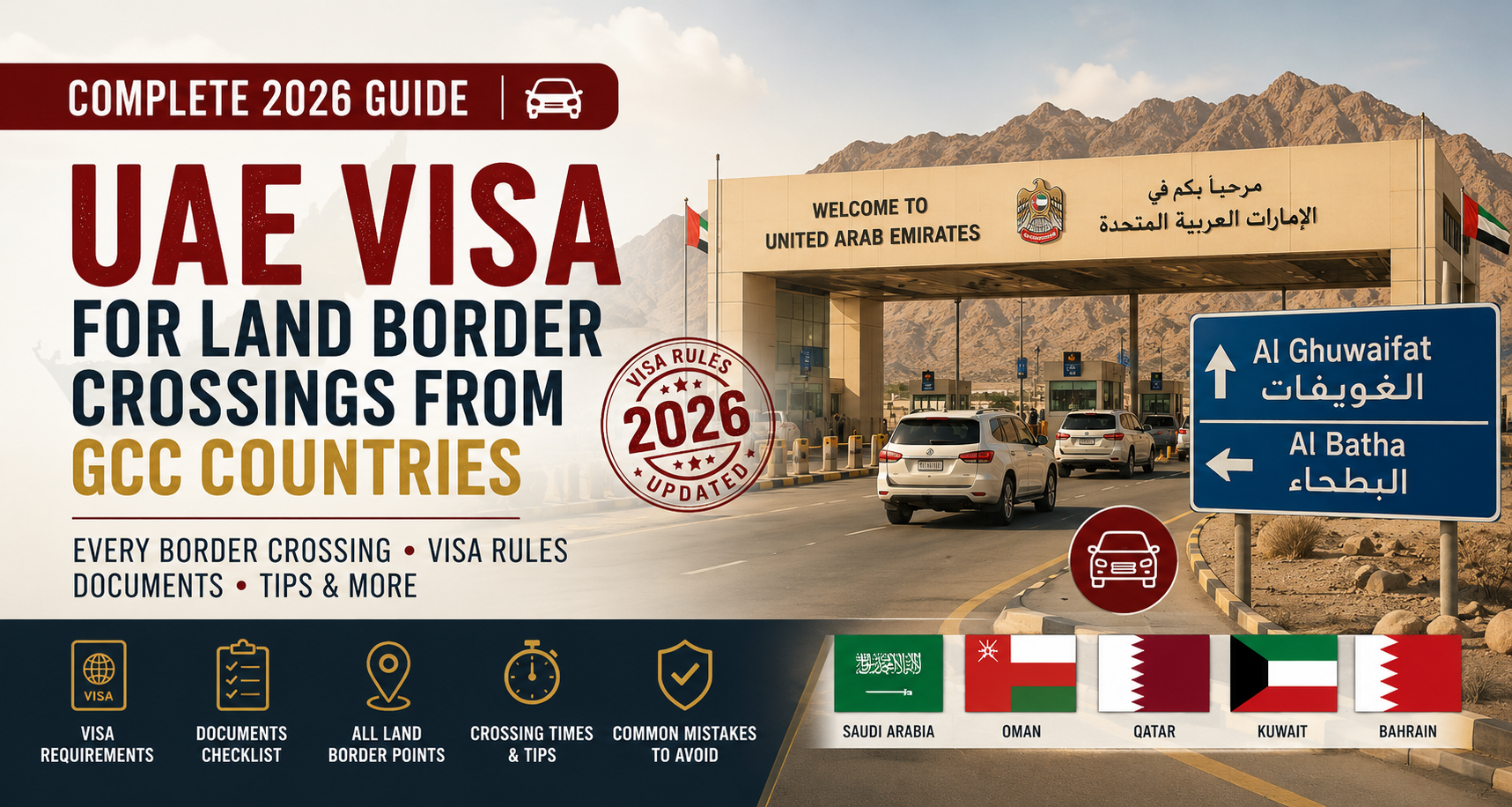
All UAE Land Border Crossings from GCC Countries (2026)

There are two sets of UAE land borders: those shared with Saudi Arabia (one crossing) and those shared with Oman (five main crossings). Qatar, Kuwait, and Bahrain travellers must transit through Saudi Arabia first and enter the UAE via the Saudi–UAE crossing.

πŸ‡ΈπŸ‡¦ Saudi Arabia → UAE: Al Ghuwaifat / Al Batha Border


Al Ghuwaifat (UAE) — Al Batha (Saudi Arabia)

The only land border between Saudi Arabia and the UAE. Located in the western Abu Dhabi region. This single crossing handles all overland traffic between the two countries — including travellers transiting from Qatar, Kuwait and Bahrain.

Distance from Dubai: ~420 km (4–5 hrs driving)
Distance from Abu Dhabi: ~280 km (2.5–3 hrs driving)
Distance from Riyadh: ~1,150 km (9–12 hrs driving)

βœ“ Open 24/7


Step-by-step: crossing Al Ghuwaifat into UAE

Saudi exit — passport control

Hand over your passport at the Saudi exit booth. You receive an exit stamp. GCC nationals use the fast lane — process is 5–10 minutes.

Saudi customs — vehicle check

Brief vehicle inspection. Declare any cash above SAR 60,000 (or equivalent). Do not carry prohibited items — medicines, certain foods, and large cash amounts require declarations.

Neutral zone — drive across

Drive through the no-man's land between Saudi and UAE territory. This stretch is 2–3 km.

UAE immigration — passport stamp + biometrics

Non-GCC nationals: hand over passport and approved eVisa printout. Biometric scan (fingerprints + retinal scan) on first UAE entry. GCC nationals use the separate fast lane — national ID or passport accepted.

UAE customs — vehicle check

Declare cash above AED 100,000. Prohibited and restricted items are checked. Once cleared, you are in the UAE.

Peak hours to avoid at Al Ghuwaifat: Thursday evenings and Fridays from noon onwards see queues of 2–4+ hours for private vehicles. Eid holidays can see waits of 6–8 hours. Cross before 8 AM or after 9 PM on weekdays for the smoothest experience.

πŸ‡ΆπŸ‡¦ Qatar  |  πŸ‡°πŸ‡Ό Kuwait  |  πŸ‡§πŸ‡­ Bahrain → UAE via Saudi Arabia

There is no direct land border between Qatar, Kuwait or Bahrain and the UAE. Travellers from these three countries must:

  1. Cross from their country into Saudi Arabia at their respective border
  2. Drive across Saudi Arabia (transit)
  3. Enter the UAE via Al Ghuwaifat / Al Batha crossing
Origin Saudi Entry Border Approx. Drive to UAE Border Total to Dubai
πŸ‡ΆπŸ‡¦ Qatar (Doha) Salwa / Abu Samra ~7 hrs across Saudi ~11–13 hrs
πŸ‡°πŸ‡Ό Kuwait Al Khafji / Nuwaiseeb ~9 hrs across Saudi ~13–15 hrs
πŸ‡§πŸ‡­ Bahrain (Manama) King Fahd Causeway ~8 hrs across Saudi ~12–14 hrs


Important for transit through Saudi Arabia: Non-GCC nationals driving through Saudi Arabia must hold a valid Saudi transit or tourist visa in addition to their UAE eVisa. GCC nationals can transit Saudi Arabia without additional visas using their GCC ID or passport.


1.Hatta – Al Wajajah

Best for: Muscat → Dubai / Sharjah
Distance from Dubai: ~130 km
Distance from Muscat: ~320 km
Open to all nationalities with valid documents
Busiest crossing. Peak wait: 1–2 hrs weekends.

βœ“ 24/7

2.Mezyad – Hafeet (Al Ain)

Best for: Muscat → Abu Dhabi / Al Ain
Also serves: Al Buraimi, Ibri, interior Oman
Multiple checkpoints — some GCC-only lanes
International travellers use Mezyad / Hafeet post.

βœ“ 24/7

3.Khatmat Malaha (Kalba)

Best for: Sohar → Fujairah
Open to all nationalities
Lighter traffic than Hatta — faster processing at off-peak hours.

βœ“ 24/7

4.Dibba Checkpoint (Musandam)

Best for: Khasab / east Musandam → Fujairah / Dibba
Note: Musandam is a non-contiguous Omani exclave — separate entry/exit rules may apply.

Check hours

5.Khatam Al Shiklah (Al Ain)

Best for: Cargo and limited passenger travel
Mainly used for commercial vehicles toward interior Oman / Sohar / Al Buraimi.

Mostly cargo

6.Al Dhara Border Post

Best for: Western coastal road to Khasab
Less-used crossing — verify hours before travel.

Check hours

Which Oman–UAE border should I use? Simple rule: Muscat to Dubai → Hatta. Muscat to Abu Dhabi → Mezyad/Hafeet. Sohar to Fujairah → Khatmat Malaha. Choosing the wrong crossing can add 2+ hours to your journey.

UAE Visa Requirements at Land Borders — The Critical Details

The single-entry visa problem (most common mistake)

This is the issue that catches the most travellers. Exiting the UAE via any land border consumes a single-entry UAE visa. Your visa is considered used the moment you exit UAE territory — even if you were only in Oman for an afternoon and came straight back.

Example: You hold a 30-day single-entry UAE tourist visa. You drive from Dubai to Oman via Hatta for a weekend trip. When you try to re-enter the UAE at Hatta, your single-entry visa has already been consumed on your first entry. You will be denied re-entry.

Solution: If you plan to exit and re-enter the UAE by road, always apply for a multiple-entry UAE visa.

Visa on arrival is NOT available at land borders

UAE airports (Dubai, Abu Dhabi, Sharjah) process visa-on-arrival for eligible nationalities. Land borders do not. There are no UAE visa counters at Al Ghuwaifat, Hatta, Mezyad, Khatmat Malaha or any other land crossing. Your visa must be approved and received by email before you leave for the border.

GCC residency permit validity requirements


Requirement Details
GCC residency permit validity Minimum 1 year remaining from UAE arrival date (official ICP requirement)
Passport validity Minimum 6 months from UAE arrival date
UAE eVisa validity at land border Must be valid on the day of crossing — check issue date and expiry
Family members Each family member requires their own UAE eVisa (companions of GCC residents qualify for the same visa category)


Documents Checklist for Land Border Crossing into UAE

For GCC nationals

  • Valid passport or GCC national ID card (either is accepted)
  • Vehicle registration (if driving your own car)
  • Valid vehicle insurance covering UAE territory

For non-GCC nationals (expats in GCC countries)

  • Valid passport — minimum 6 months validity

  • Approved UAE eVisa — printed copy recommended, digital copy on phone as backup
  • Valid GCC residency permit / Iqama — minimum 1 year remaining validity
  • Vehicle registration (if driving)
  • Valid UAE-coverage vehicle insurance (mandatory)
  • Return or onward travel proof (not always asked, but carry it)

Pro tip: Always carry a printed copy of your UAE eVisa email confirmation. Border immigration systems can be slow, and having a physical printout prevents delays if the officer cannot pull up your application digitally.


Driving Your Own Car Across the UAE Land Border

If you are driving a privately-registered vehicle, additional rules apply beyond passport and visa requirements.

 
Item Requirement
Vehicle insurance Must be valid in UAE. If your Saudi/Oman/Qatar policy does not cover UAE, purchase a UAE border insurance policy before crossing. Available from agents at the border approach roads.
Vehicle registration card Original document required — not a photocopy
RTA Tourism Certificate Required for Dubai-registered vehicles exiting UAE. Obtain from RTA before your trip.
Cash declaration Declare cash above AED 100,000 (or currency equivalent) at UAE customs
Prohibited items Certain medications, large quantities of food, and specific goods require customs declaration or may be prohibited. Check UAE customs rules before packing.


Best Times to Cross — and When to Avoid

Border Best Times Avoid
Al Ghuwaifat (Saudi–UAE) Weekdays before 8 AM or after 9 PM Thursday evening, Friday noon–evening, Eid holidays
Hatta – Al Wajajah (Oman–UAE) Weekdays 8–11 AM Friday–Saturday, public holidays (1–2 hr wait)
Mezyad – Hafeet (Al Ain–Oman) Early morning on weekdays Weekend afternoons
Khatmat Malaha (Kalba–Oman) Any weekday — generally light traffic Long weekends


UAE Visa on Arrival at Land Borders — Nationality-by-Nationality

To be clear: no nationality receives a UAE visa at the land border itself. However, some nationalities are entitled to a UAE visa on arrival when arriving at UAE airports. If you hold one of these passports and are crossing by land, you still need to apply for a UAE eVisa in advance:

Nationality Airport rule Land border rule
GCC nationals (Saudi, Kuwaiti, Qatari, Bahraini, Omani) Visa-free 30 days Visa-free — national ID accepted
Indian passport holders Visa on arrival — 14 days (with qualifying visa) Must apply for UAE eVisa in advance
Filipino, Indonesian, Thai, Vietnamese Visa on arrival — 14–60 days (June 2026 rules) Must apply for UAE eVisa in advance
All other nationalities requiring a visa Apply in advance or visa on arrival varies Must apply for UAE eVisa in advance


Don't Get Turned Back at the Border

Apply for your UAE eVisa now — approved and emailed within 24–72 hours. Expert-reviewed, 150+ nationalities supported, 50,000+ visas processed.

Apply for UAE eVisa →


Common Problems at UAE Land Borders — and How to Solve Them

Problem Why it happens Solution
Turned back at border — no visa Assumed visa on arrival available at land border Apply for UAE eVisa before departure — minimum 48–72 hrs in advance
Single-entry visa consumed — can't re-enter Drove out of UAE and back on same trip Always use multiple-entry visa if you plan to cross and return
GCC residency rejected — insufficient validity Iqama had less than 1 year remaining Renew residency before applying for UAE visa
Vehicle insurance rejected at UAE customs Policy did not cover UAE territory Purchase UAE extension insurance from agents before the border
Long queue — missed travel plans Crossed on Thursday evening or during Eid Cross on weekday mornings — before 8 AM is consistently fast
eVisa rejected — profession not approved UAE eVisa for GCC residents has approved profession list Use expert visa facilitation service — we screen profession eligibility before submission